Lodi carries a reputation built on vineyards, lake mornings, and a small-city character that sets it apart from the larger urban centers of San Joaquin County. But behind the wine trails and the easy pace of life along Lodi Lake, there’s a working healthcare community that operates with the same urgency and professional accountability as any major metropolitan clinical system. Nurses, paramedics, respiratory therapists, and emergency technicians serving Lodi and the surrounding valley floor don’t get the luxury of a slow day when cardiac emergencies strike. And they don’t get extensions on their BLS, ACLS, and PALS renewal deadlines either — regardless of how demanding their schedules become.
The healthcare picture in San Joaquin County is more acute than Lodi’s relaxed exterior might suggest. The American Heart Association estimates that sudden cardiac arrest claims more than 350,000 lives annually in the United States, with a significant proportion occurring in community settings — exactly the residential neighborhoods, agricultural workplaces, and family-oriented areas that define communities like Sunwest, Reynolds Ranch, and the Downtown Lodi corridor. Clinical professionals at Adventist Health Lodi Memorial — the community’s primary acute care facility on South Fairmont Avenue — and those commuting to larger regional facilities in Stockton make up a workforce that depends on current, valid emergency response training every single shift. That dependency doesn’t pause when scheduling gets complicated.
This guide examines the two primary pathways available for completing BLS, ACLS, and PALS courses in Lodi: traditional instructor-led classroom training and the increasingly preferred Self-Guided Learning™ model paired with CPR Verification Station™ learning centers. Both lead to successfully completing the course and receiving an AHA Course Completion eCard. Which one actually fits the professional lives of healthcare workers in San Joaquin County’s wine country city is a question worth answering clearly.
Overview of CPR Training Options in Lodi
Healthcare professionals in Lodi and neighboring communities like Stockton, Galt, and Woodbridge have two distinct training formats to consider when approaching their BLS, ACLS, or PALS renewal:
- Instructor-Led Training — A fixed-schedule, in-person classroom session where a course instructor guides participants through both cognitive content and hands-on skills practice in a single multi-hour block, typically running four to eight hours depending on the program level.
- Self-Guided Learning™ + CPR Verification Stations — A flexible two-component model where learners complete an adaptive online course at their own pace, then attend a focused skills evaluation at a CPR Verification Station™ learning center for objective, technology-driven performance assessment.
Both formats satisfy AHA requirements and result in an AHA Course Completion eCard. The difference lies in the journey — and how much that journey demands from a working professional’s already stretched schedule.
Traditional Instructor-Led CPR Training in Lodi
Instructor-led training has served as the standard delivery format for AHA BLS, ACLS, and PALS programs throughout San Joaquin County for many years. The model is familiar: participants gather at a scheduled facility, follow AHA-approved curriculum content under the direct guidance of a course instructor, and work through hands-on skill rotations covering chest compressions, airway management, defibrillation, and increasingly complex resuscitation scenarios as the course level rises from BLS through ACLS and PALS.
For clinical teams at Adventist Health Lodi Memorial whose departments coordinate group sessions on-site, this format has historically provided a manageable structure when institutional logistics handle the scheduling. Healthcare workers commuting between Lodi and St. Joseph’s Medical Center in Stockton or San Joaquin General Hospital in French Camp have also accessed employer-coordinated sessions in this format. The friction begins when individual professionals need to independently locate, register for, and attend a session that actually fits their availability.
How Instructor-Led Training Works
A standard BLS class in Lodi’s instructor-led format runs between two and a half and four hours. ACLS courses are considerably more demanding on time — six to eight hours is typical — covering advanced cardiac rhythm recognition, pharmacology protocols, airway management techniques, and multi-role team resuscitation scenarios that require sustained hands-on practice across multiple skill stations. PALS programs follow a comparable timeline through a pediatric lens, with age-specific clinical frameworks demanding careful, deliberate attention throughout.
Throughout the session, the trainer observes each participant’s technique at the skill stations, provides real-time verbal coaching, and confirms competency against AHA standards before signing off. When all components are successfully cleared, learners complete the course and receive their AHA Course Completion eCard. For participants encountering advanced clinical material for the first time, the live trainer presence can be genuinely valuable — offering context and correction that static content alone can’t always replicate.
Limitations of Instructor-Led Classes
The limitations become apparent quickly for anyone embedded in Lodi’s real-world healthcare environment. The city sits along Highway 99 in the San Joaquin Valley — a corridor that services an enormous volume of regional traffic, particularly during the agricultural shipping seasons that define the rhythm of life throughout the valley floor. A healthcare worker in the Reynolds Ranch neighborhood who needs to drive south to Stockton for a training session is absorbing substantial travel time on top of an already long day. For those commuting north toward Sacramento for an ACLS program, the time investment grows further.
Schedule scarcity compounds the challenge. ACLS and PALS sessions at major San Joaquin County training sites fill weeks in advance during peak renewal periods. A nurse based near the Downtown Lodi corridor whose employer compliance window is approaching may find that every available classroom session within driving distance is already booked — leaving waitlisting as the only option when deadlines don’t accommodate delays. For shift workers at Adventist Health Lodi Memorial managing rotating patterns, the prospect of blocking a fixed full day from an unpredictable schedule isn’t just inconvenient. It’s often genuinely impossible without creating coverage gaps that affect patient care.
The Rise of CPR Verification Stations in Lodi
As San Joaquin County’s healthcare workforce has grown more diverse, more schedule-intensive, and more geographically distributed across the valley, the limitations of the traditional classroom model have become increasingly difficult to work around. CPR Verification Stations have emerged as the practical, technology-driven response to that gap — shifting the skills evaluation process away from group-paced, observer-dependent classroom settings toward a learner-controlled, objectively measured verification system that fits the way today’s clinical professionals actually operate.
Adoption across the greater Stockton-Lodi area has grown steadily as training providers and healthcare employers have recognized the direct connection between scheduling rigidity and delayed compliance. Incorporating CPR Verification Station-based evaluation into program offerings has become a meaningful differentiator for providers serving communities where the traditional model has consistently created bottlenecks.
What Is a CPR Verification Station?
A CPR Verification Station™ learning center is a precision technology system built around sensor-equipped manikins that capture real-time, granular performance data throughout a CPR skills evaluation. Every compression is measured for depth, rate, hand placement, and full chest recoil. Every ventilation is tracked for timing and volume. All of that data is assessed automatically against current AHA performance standards, producing immediate, objective feedback that doesn’t depend on an instructor’s observation angle, attention level during a crowded session, or any other variable outside the learner’s own demonstrated technique.
For Lodi’s clinical professionals — many of whom work in environments where performance standards are measured, documented, and reviewed — a skills assessment system operating on those same principles of consistent, objective measurement carries genuine professional weight. The evaluation is the same regardless of time, place, or session size. What matters is what the sensors capture.
How Self-Guided BLS, ACLS, and PALS Courses Work
The online knowledge component of the Self-Guided Learning™ model is delivered through the HeartCode® Complete course — the AHA’s approved digital curriculum for BLS, ACLS, and PALS programs. What distinguishes HeartCode® from a conventional online training module is the intelligence embedded in how it responds to each learner: True Adaptive™ learning powered by Area9 Lyceum.
This platform monitors how each participant engages with course material in real time and continuously adjusts the learning experience based on demonstrated understanding. An experienced ICU nurse from Lodi’s Sunwest neighborhood renewing her ACLS course doesn’t spend an hour reviewing rhythm recognition concepts she applies daily at the bedside — True Adaptive™ learning powered by Area9 Lyceum identifies her existing competency with that material and advances accordingly, directing reinforcement only to the areas where genuine gaps appear. A newer paramedic working through the PALS program encounters a meaningfully different experience — one that paces more deliberately, revisits challenging pediatric assessment concepts, and confirms comprehension at each stage before moving forward.
Once HeartCode® Complete is finished, the participant schedules a brief, targeted skills session at a nearby CPR Verification Station™ location. The hands-on evaluation is focused, time-efficient, and generates an objective performance record against AHA criteria. The AHA Course Completion eCard follows.
Key Advantages of CPR Verification Stations
For healthcare professionals across Lodi and surrounding San Joaquin County communities including Stockton, Galt, and Woodbridge, the practical benefits of this model are concrete and immediately relevant:
- Full scheduling freedom — The HeartCode® Complete online course can be started, paused, and completed across any timeframe — evenings after shifts, weekend mornings, or distributed across multiple sessions over a week or more.
- Meaningful time efficiency — True Adaptive™ learning powered by Area9 Lyceum eliminates redundant review for experienced clinicians, reducing total course time compared to the uniform pace of a traditional classroom day.
- Consistent, objective evaluation — CPR Verification Station™ technology applies standardized AHA performance criteria uniformly, removing the variability that comes with human observation across different sessions and instructors.
- Locally accessible — Shorter, more flexibly bookable skills sessions fit around a Lodi professional’s actual weekly calendar far more naturally than a blocked full-day classroom commitment.
Why Healthcare Professionals in Lodi Prefer Self-Guided Learning
The neighborhoods of Reynolds Ranch and the communities stretching along the Turner Road and Harney Lane corridors are home to a significant concentration of clinical workers who understand exactly what schedule pressure looks like. Many work rotating shifts at Adventist Health Lodi Memorial or commute regularly to larger San Joaquin County facilities. Some carry per diem arrangements across multiple clinical settings, making it essentially impossible to commit to a fixed training date weeks in advance. Others are managing family and community obligations alongside professional requirements in a community built, at its core, around family life.
Self-Guided Learning™ courses resolve the tension between those competing demands. A home health nurse serving the Sunwest neighborhood and surrounding areas can complete the BLS program online across several evenings at home, then book a focused skills session at a nearby CPR Verification Station™ location when her week permits — not when a classroom calendar has an opening. A respiratory therapist rotating between Lodi and Stockton-area facilities can work through the ACLS course online between shifts, handling the cognitive component without sacrificing precious days off, and then completing the hands-on evaluation at a time that fits. That kind of genuine flexibility isn’t a reduction in training quality. It’s a direct upgrade in how accessible quality training actually is.
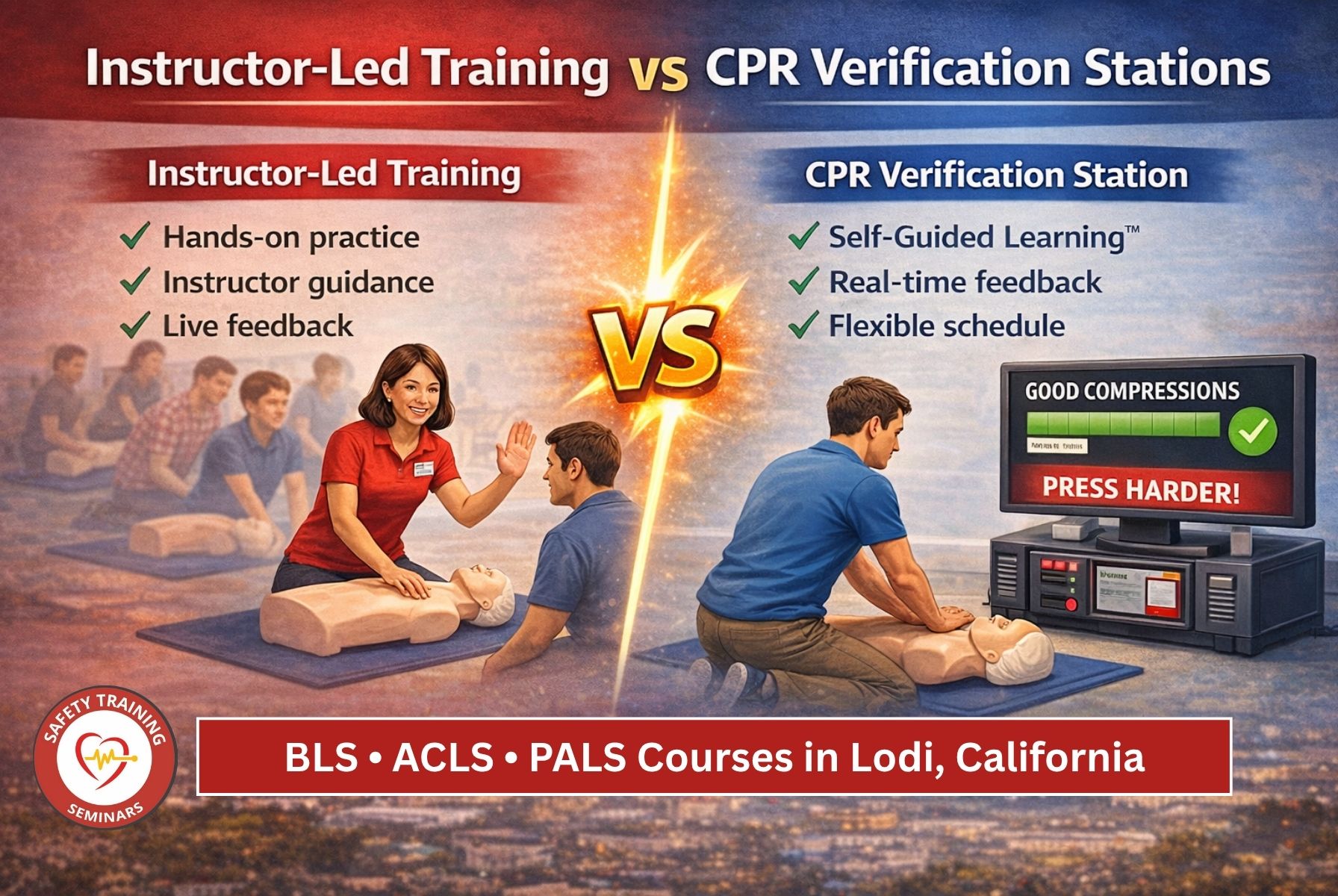
Instructor-Led vs. CPR Verification Stations: Side-by-Side Comparison
Placed directly alongside each other, these two formats reveal fundamentally different assumptions about whose needs the training process should serve. Instructor-led programs are structured around the delivery event — a fixed date, a fixed location, and a pace that applies uniformly to everyone in the room regardless of their clinical experience, specialty background, or how much they already know about the material being covered. That structure can support certain learners in certain contexts. For most working healthcare professionals in a community like Lodi, it’s simply misaligned with the unpredictability of real clinical schedules.
Self-Guided Learning™ with CPR Verification Stations is structured around the learner from start to finish. HeartCode® Complete adapts content to demonstrated knowledge through True Adaptive™ intelligence, ensuring no time is wasted on material that’s already mastered. The CPR Verification Station™ skills session is brief, focused, and scored by technology that applies the same standard every time. Neither component requires clearing a full day or committing to a location weeks in advance. On flexibility, time efficiency, scheduling accessibility, and consistency of evaluation, the Self-Guided Learning™ model holds a clear and meaningful advantage — and those dimensions are exactly what determine whether a busy Lodi-area healthcare professional can actually get their renewal completed before the deadline.
Which Option Is Better for You in Lodi?
Instructor-led training is the right fit if you’re completing an ACLS or PALS program for the very first time and genuinely benefit from the structure of a live, group-learning environment. Some participants — particularly those encountering team-based resuscitation scenarios or pediatric emergency protocols for the first time — find that working through complex clinical content alongside peers, with a course instructor physically present to answer questions and demonstrate technique, builds a level of foundational confidence that’s harder to replicate independently. If the material is new and your schedule allows, the classroom format has genuine value.
Self-Guided Learning™ is the stronger choice if you’re renewing familiar coursework, your schedule shifts unpredictably, or you need an efficient path to completing your BLS class in Lodi, finishing your ACLS program before a compliance deadline, or wrapping up your PALS course without surrendering a full day off. For the majority of experienced clinical professionals working across San Joaquin County, this is the format that was designed for how healthcare work actually operates.
Local Demand for CPR BLS, ACLS, and PALS Training in Lodi
The renewal pipeline across San Joaquin County is active and consistent throughout the year. Adventist Health Lodi Memorial is the primary acute care facility serving the immediate Lodi community and maintains ongoing BLS, ACLS, and PALS compliance requirements across its clinical departments. Professionals regularly commute to St. Joseph’s Medical Center in Stockton, Dameron Hospital, San Joaquin General Hospital in French Camp, and Kaiser Permanente Stockton — all of which maintain their own active renewal schedules for AHA-trained clinical staff.
The Lodi Fire Department adds its own contingent of emergency responders to the local AHA training renewal pool. With two-year renewal cycles running continuously across these organizations and a San Joaquin County population that continues to grow alongside regional agricultural and commercial expansion, the demand for accessible BLS CPR training near Lodi is sustained and substantial throughout the calendar year. The increasingly visible shift toward flexible training formats is a direct reflection of a workforce that has outgrown the assumptions embedded in the traditional classroom model.
How Safety Training Seminars Supports Modern CPR Training
Safety Training Seminars supports healthcare professionals across Lodi, Stockton, Galt, and the broader San Joaquin County region by offering both instructor-led options and the Self-Guided Learning™ model backed by CPR Verification Station™ learning centers — giving every participant a pathway that genuinely aligns with their schedule, their experience level, and their professional requirements.
Available programs include BLS, ACLS, PALS, NRP, and First Aid, covering the complete spectrum of AHA training needs across clinical and non-clinical roles throughout the region. The combination of quality curriculum, genuine scheduling flexibility, and accessible local skills verification has built a strong reputation for Safety Training Seminars among healthcare teams in the San Joaquin Valley — one grounded in understanding what working professionals actually need rather than what’s easiest to deliver.
The Future of CPR Training in Lodi
The direction of healthcare training innovation is consistent and accelerating. Personalized, technology-integrated learning experiences that adapt to individual knowledge and respect the complexity of modern clinical schedules are progressively replacing the one-size-fits-all classroom model across the industry. True Adaptive™ learning powered by Area9 Lyceum and CPR Verification Stations sit at the forefront of that shift, and the healthcare organizations in San Joaquin County that have already moved in this direction are seeing real improvements in training efficiency, compliance rates, and learner engagement.
For Lodi’s clinical community, this evolution isn’t a distant industry trend to monitor from afar. It’s an available, practical option today — already changing how the region’s most pragmatic healthcare professionals approach their AHA renewal requirements, one course completion at a time.
Start Your BLS, ACLS, or PALS Course in Lodi Today
Whether you’re working through a BLS course in Lodi for the first time or renewing your ACLS program with a compliance window closing in, a training pathway built for your schedule and your professional life is available right now. Healthcare professionals across San Joaquin County — from Sunwest to Reynolds Ranch, from Woodbridge to Stockton — are already completing their programs through the Self-Guided Learning™ model, receiving their AHA Course Completion eCard, and returning to their clinical roles without the disruption and delay of a mandatory full-day classroom commitment.
Don’t let a fully booked session or an inflexible schedule push your renewal into non-compliance. Choose the format that fits your life, complete your BLS, PALS, or ACLS training in Lodi on your own terms, and stay current with the skills that define your professional standard.